
Maple Grove Wood Flooring has done engineered hardwood refinishing in Maple Grove, MN for more than 20 years, serving surrounding cities including Dayton, Brooklyn Park, Champlin, Corcoran and Plymouth. It is the service where the answer most often has to be no, and saying so early is the whole value of the visit.
Engineered flooring is real wood over a stable core, and the real wood on top is a finite resource. Sanding consumes it. Where the layer is thick enough, an engineered floor refinishes like any other and comes back looking new. Where it is not, a grit sequence goes straight through into the plywood and the floor is finished for good — an outcome no finish repairs and no apology reverses.
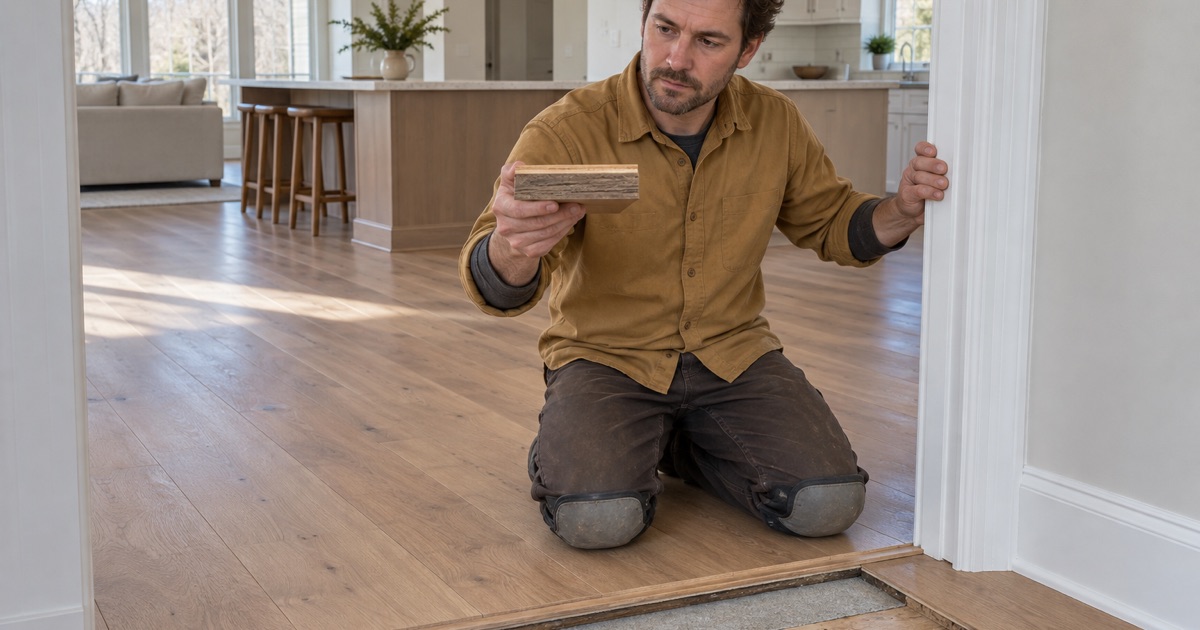
So we measure the wear layer before quoting an engineered floor for sanding. That measurement takes a few minutes at a vent cut or a threshold, costs nothing, and settles the question that everything else on the quote depends on. Under the threshold, the honest answer is a recoat or a replacement, and that is what you will hear.
Measuring the Wear Layer First
Where the Measurement Comes From
We take it where a board section is already exposed: a floor vent cut, a threshold, the underside of a stair nosing, or a leftover plank from the builder if one survives in the garage. Where none of those exist, a single board in a closet comes up and goes back down. What we will not do is guess from the product name, because manufacturers sell the same visual in several thicknesses and the difference between them is the entire decision.
The Threshold Between Refinish and Replace
What matters is the solid wood above the core, not the total thickness of the plank, and a two-millimeter wear layer does not survive a full grit sequence. Engineered and refinishable are two different purchases, and plenty of floors were sold as the first while the buyer heard the second. When the number says replacement, we put the replacement cost next to the refinish cost so the arithmetic is visible rather than asserted.
What a Light Sanding Can Still Do
Between a full sanding and a simple recoat there is room for a lighter cut, and on a moderate wear layer that is often the right answer. A single fine pass takes off surface damage without eating the layer, and the floor comes back with most of its remaining life intact. We set the cut depth against the measurement rather than running the same sequence we would use on a three-quarter-inch solid floor.
Recoating Instead of Sanding
Screen and Recoat on a Thin Wear Layer
A screen and recoat never exposes wood, so the wear layer question largely goes away. An abrasive screen abrades the existing finish enough for a new coat to bond, and that coat restores sheen, evens out traffic lanes and adds fresh wear surface. It does nothing for scratches that reached the wood, and nothing for color. For a thin engineered floor with a tired finish, it is by some distance the best value on this page.
Factory Finishes and Adhesion
Most prefinished engineered flooring ships with a very hard cured factory coating, and that coating is designed specifically so nothing sticks to it. Recoating over it without proper abrasion and the right bonding system produces adhesion failure, and engineered floors peel in sheets rather than in patches. We test adhesion on a small area before committing a room, because finding out afterward means removing a coat that did not want to be there.
Sheen, Bevels and What a Recoat Changes
A recoat spans the micro-bevels between boards, which subtly changes how the floor reads: the joint lines soften and the surface looks a little more continuous. Most people like it and some do not, so it is worth knowing before rather than after. Sheen is a free choice at this point, and moving from a factory gloss to a satin hides far more of the daily traffic in a busy house.
When Refinishing Is the Wrong Answer
Delamination and Moisture From Below
Where the wear layer is lifting from the core, sanding removes the only material still holding the board together. Those boards get replaced rather than refinished. Widespread delamination is a message about moisture underneath, so on a lower level we read the slab itself before quoting any surface work — refinishing a floor that is still being fed water from below buys a year at most.
Replacement Arithmetic on a Thin Floor
When the wear layer rules out sanding, the comparison is a recoat now against a replacement later, and both numbers belong on the table. A recoat is cheap and buys real time. A replacement is the point at which the floor’s construction can be matched to the level properly — which below grade means engineered or floating rather than solid, whatever the last installer put down.
Repairing Boards Without Refinishing the Room
Individual damaged boards can be swapped on an engineered floor without touching the rest, and on a prefinished product that is often better than any refinish. The constraint is sourcing: original product, close discontinued stock, or boards harvested from a closet. We show you the match in your own light before installation, because a board that looks identical in a van rarely looks identical next to a window.
- 20+ Years Experience
- Written Price Per Square Foot
- Moisture Tested Before Quoting