
Maple Grove Wood Flooring has handled hardwood floor repair in Maple Grove, MN for more than 20 years, serving surrounding cities including Dayton, Brooklyn Park, Champlin, Corcoran and Plymouth. Most of that work is on floors that are not failing — they are twenty, thirty or forty years old with one thing wrong: a row of stained boards at a dishwasher, a squeak at the top of the stairs, a hollow patch where a glue-down let go. One thing wrong is a repair, and a repair is almost always cheaper than the replacement somebody else quoted.
The work splits cleanly into two questions. What is wrong with the wood you can see, and what is wrong with whatever is holding it up. The second one is where repairs go wrong, because a board replaced over a wet subfloor or a deflecting joist fails again in the same spot within a season, and the second visit costs more than getting it right the first time.
So every repair starts with meters and a floor plan rather than a quote. We read moisture in the boards and the subfloor, sound the field for dead areas, look from below wherever there is access, and establish whether the damage is finished, ongoing or structural. Only then does a number get written, and structural subfloor work gets written as its own line rather than folded into finish work.
The Repairs We Do Most in Maple Grove Homes
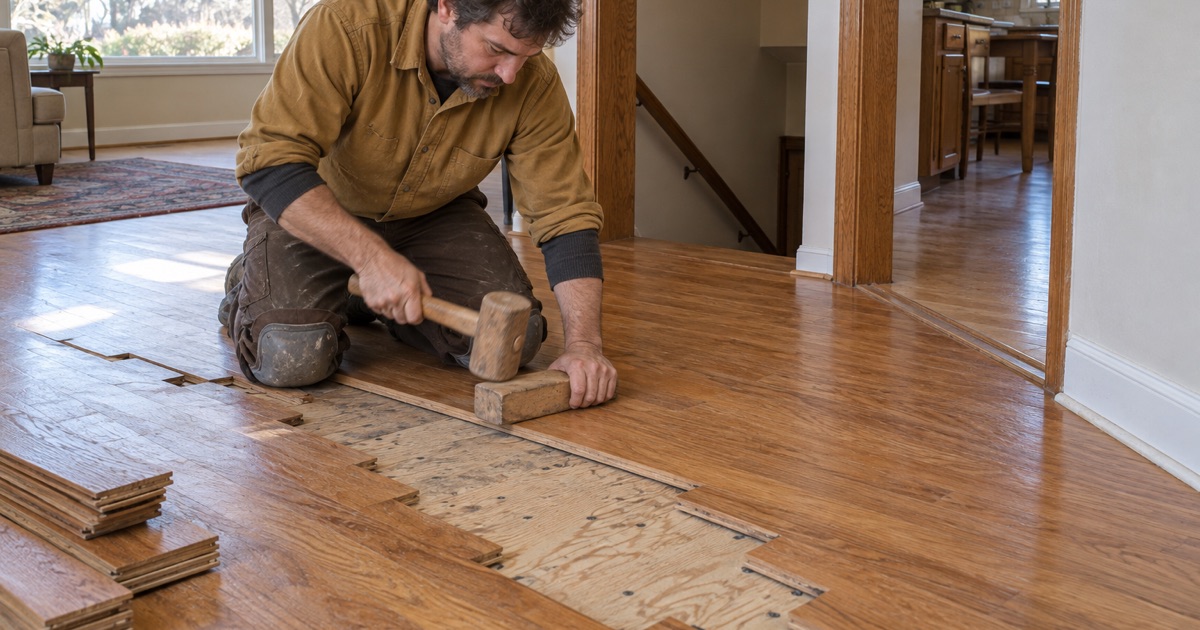
Board Replacement and Weave-In
Damaged boards are cut out individually, the tongue and groove relieved so the replacement seats without disturbing what surrounds it, and the new piece fastened to the same schedule as the original floor. Where the damage runs in a straight line across several rows, we weave the replacement in with staggered end joints instead of leaving a rectangular patch that reads as a patch forever. On a site-finished floor the seam disappears entirely under the sanding that follows. On a prefinished floor the goal is a close match with a sample you have seen first, and we say so up front rather than after installation.
Squeaks, Ticking and Loose Fasteners
A squeak is wood moving against a fastener, while a tick or a pop is usually a subfloor panel lifting off a joist and dropping back. They sound similar underfoot and take completely different repairs, which is why locating the source comes before anything gets screwed or shimmed. With access from below we work in the joist bay with blocking, adhesive and shims, and the finished floor is never touched. Where the basement ceiling is finished, the repair comes through the top and is plugged or filled to match, and we tell you which of the two your house allows before you commit.
Hollow Spots and Failed Adhesive Bond
A floor that sounds hollow under a knuckle has separated from what is beneath it. On a glue-down that is adhesion failure, often traced back to a slab that was never tested or a bond broken by moisture from below. On a nail-down it is usually fastener spacing that was too generous for the species and width. We map the dead zone by sounding the whole field rather than the one spot you noticed, because the audible patch is generally smaller than the failure, and we fix the bond rather than face-nailing over it.
Damage That Starts Underneath the Floor
Cupping, Crowning and Compression Set
Cupping means the underside of the board is wetter than the top, so the edges rise. Crowning is the opposite profile and is very often a cupped floor that somebody sanded flat before it had dried. Compression set is the permanent version: boards swollen hard against each other crush their own edges, and when the moisture leaves, gaps open that will never close. All three are moisture stories, so we meter the flooring, the subfloor and the space beneath and find the source before touching a machine.
Subfloor Panels, Joists and Deflection
Some repairs are not flooring repairs at all. A bouncy floor with joists spanning too far, a sheathing panel that has delaminated at its edge, or a bay that was cut for plumbing and never repaired will telegraph through any flooring laid over it. We look from below wherever the ceiling allows, and where structural work is genuinely needed it is quoted separately — Minnesota exempts finish flooring from a building permit but not joists, sheathing replacement or changes to floor framing, and pretending those are the same job helps nobody.
Powderpost Beetle Holes and Insect Damage
Small round holes in a board are sometimes a dropped tool and sometimes powderpost beetle exit holes. The tell is fresh, pale frass sifting out of the holes, which points at something active rather than damage that has been sitting there since the Reagan administration. This matters because refinishing over an active infestation seals the surface and leaves the problem working underneath a brand-new finish. We look before we fill, and where it is active the pest work comes first.
Matching an Old Floor to New Wood
Species, Cut and Grade
Matching starts before color. Red oak and white oak look different once finished, plainsawn and quartersawn show completely different figure, and board width and grade have to line up or the repair reads as a stripe. Most 1970s to 1990s floors in this area are plainsawn red oak strip in a standard width, which is good news for sourcing. Older and wider floors take more hunting, and occasionally the best match is boards harvested from a closet floor that nobody sees.
Prefinished Boards and the Bevel Problem
A prefinished floor carries a factory finish and usually a micro-bevel at every board edge, and both are hard to reproduce on site. Where the original product is still made we order it. Where it is discontinued we look for close stock and show you a sample in your own light before installation, because a match that looks right in a van looks different next to a window. Sometimes the honest recommendation is a full-room refinish instead.
Blending Stain and Sheen at the Seam
On a site-finished floor the repair seam vanishes because the whole area is sanded and coated as one surface. Where only part of a floor is being redone, the seam is placed at a doorway or a natural break rather than in the middle of open field, and stain and sheen are matched with sample panels on your boards. Sheen mismatch is the one that gives a repair away, and it is more obvious than a slight color difference.
Repair, Refinish or Replace
When a Patch Is Enough
If the floor is otherwise sound, the finish still has life in it, and the damage is contained, a patch plus a blended finish is the whole job. This is the outcome we are aiming for on most calls, and it is why the first visit is diagnostic. A floor with one bad area does not need what a flooring salesperson calls a solution; it needs the bad area fixed and the rest left alone.
When the Repair Triggers a Full Sanding
Some repairs make sanding the sensible next step: several separate areas across one room, board replacement on a site-finished floor where color has to be uniform, or a floor already due for refinishing where waiting means paying for setup twice. We tell you when the arithmetic points that way and we show the two numbers side by side, rather than quietly scoping a refinish onto a repair call.
What Structural Work Adds
Where joists, sheathing or framing are involved, that work is its own line with its own price, because it sits on the other side of the state’s permit exemption from finish work. Keeping the two apart means you can see what the flooring actually costs and what the structure actually costs. It also means nobody discovers halfway through that the repair you approved has quietly become a framing job.
- 20+ Years Experience
- Written Price Per Square Foot
- Moisture Tested Before Quoting