Maple Grove Wood Flooring quotes wood flooring in Hopkins against a question most cities never raise: on the majority of these floors, the person paying for the sanding is not the person who will walk on it. That single displacement changes everything downstream — what the work is for, when it can happen, and which piece of paper it has to satisfy.
Twenty years in, we have learned that a landlord’s version of the question arrives already narrowed. It is rarely what species and almost never what sheen. It is how many days the unit sits out of service, what the work costs per square foot across a building of identical plank, and whether this floor gets through the next tenancy without a second visit.
So this page is about licenses, deposits and calendars before it is about wood. Where most floors sit in somebody’s rental, the decision to sand one is a licensing and deposit decision first, and a decorating decision a long way second.
Refinishing Wood Floors in Hopkins Rental Property
This is a rental city by a wide margin, and the census puts a number on it. Of 9,547 occupied housing units, 6,060 are renter-occupied and 3,487 are owner-occupied — 63.5 percent renter in the 2024 five-year American Community Survey. Most wood floors in this city therefore sit inside a licensed dwelling rather than an owner’s own home.
The buildings these floors are in
The stock is not mostly houses. Of 10,146 housing units, 3,002 are in buildings of 50 or more units, and 2,730 renter households — 45.0 percent of all renters — live in one of those buildings. Another 1,065 units, 10.5 percent of the total, are one-unit attached: twin homes, townhomes and rowhomes.
Age concentrates the same way. The peak decade is 1970-1979 at 2,642 units, 26.0 percent of everything standing, and 68.3 percent of the stock went up before 1980. That cohort holds most of the floors we are called about here, and it means one owner is frequently deciding for a dozen identical floors at once.
The annual license and the deficiency-point interval
Any premises rented in whole or in part as a dwelling unit needs an annual rental dwelling license under City Code article III, section 20-149, and a new license requires an inspection before it issues. After that, licensed rentals are inspected at minimum every five years, on a deficiency-point system rather than a flat calendar.
The points set the interval. Category A, at 4 or fewer points, runs roughly a five-year cycle; Category B, at 5 to 10 points, roughly three years; Category C, at 11 or more points, is inspected annually. The scoring is keyed to the substandard-dwelling definition at section 20-245, and the city enforces the 2006 International Property Maintenance Code through City Code section 8-280.
Why a refinish is still the owner’s own call
We are careful about what we have not established. We have not read a Hopkins inspection checklist, and we will not sell sanding by implying a floor sits on one. No part of this work is city-ordered, and any contractor who tells a landlord otherwise is guessing on the landlord’s money.
Refinishing a rental floor is the owner’s own maintenance decision, made for the owner’s own reasons. The unit shows better and leases sooner, a sound finish film takes the abrasion instead of the wood underneath it, and the next deposit conversation starts from a floor whose condition was recorded rather than remembered.
Looking for wood-flooring closer to Ham Lake? See Wood-Flooring Services in Ham Lake.
Wear and Tear or Damage: Floors and Security Deposits
The floor argument almost always happens at move-out, with the keys already back on the counter and a deposit sitting between two people who recall the entry hall differently. Minnesota’s deposit statute frames that argument without finishing it.
What the statute actually says about a floor
Minn. Stat. 504B.178, subdivision 3, allows a landlord to withhold from a deposit for damage to the premises, ordinary wear and tear excepted. Those five words carry the entire dispute, because the statute draws its line in general terms and never describes a floor.
So the line gets drawn by evidence instead: what the floor looked like when the tenancy began, what it looks like now, and whether the difference is a surface doing its job or something that happened to it. Our estimates describe floors in exactly those terms, in writing, because a description outlives a memory.
What the floor itself is telling you
Ordinary wear reads as a pattern. Sheen dulls along the traffic lane from the door to the kitchen, the finish thins where a chair turned for years, and the perimeter under furniture still looks close to new. That is a finish film wearing the way a finish film is built to wear.
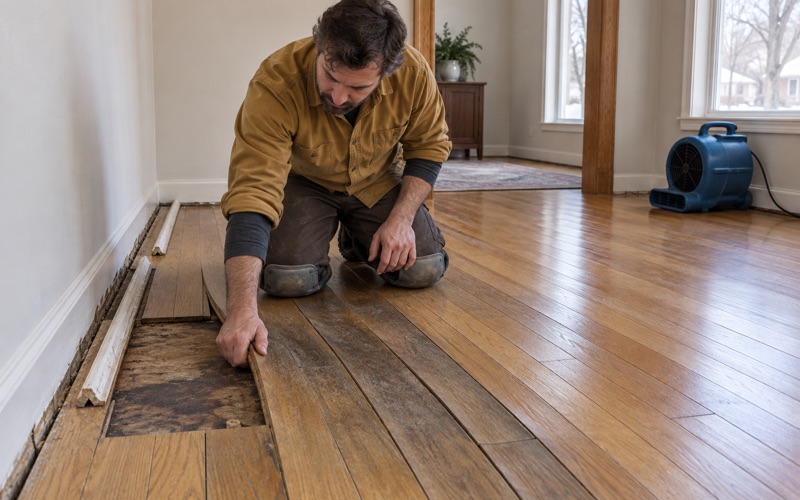
Damage reads as an outline. Cupping across the width of every board in one room, buckling where a run lifted off the subfloor, a dark stain with a rim to it, gouges that run in a direction — these have edges and addresses rather than paths, and they are what puts a repair quote next to a deposit.
Recording the floor before the lease, not after
The cheap version of this happens early. Before a tenancy starts we will put a condition line on paper room by room and price both of the paths that floor could need later, a screen and recoat or a full sand, so the number exists before anyone has a reason to dispute it.
That protects a tenant too, which is not a side benefit. A floor that wanted a recoat after several tenancies was never damaged; it was used, and the recoat was always going to be part of the cost of using it.
Refinishing Inside the Turnover Window
Between tenancies the clock is the budget. An empty unit earns nothing, so the live question is not what a sand-and-finish costs but how many days it holds the key — and the two routes through that floor are nowhere near each other in length.
Screen and recoat, or a full sand
A floor whose finish is worn but unbroken usually wants a screen and recoat: an abrasive screen to open the old coating, an adhesion test first because a bond that fails later peels in sheets rather than wearing away quietly, then fresh coats. It is the short route, and it is what most turnover floors are actually asking for.
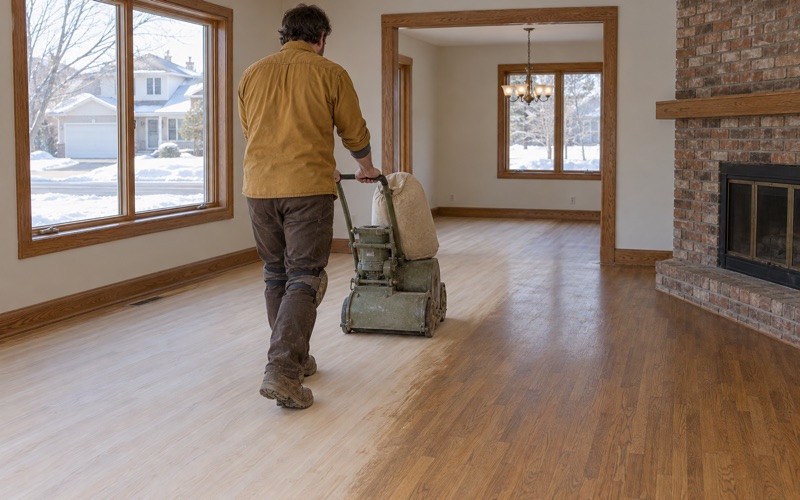
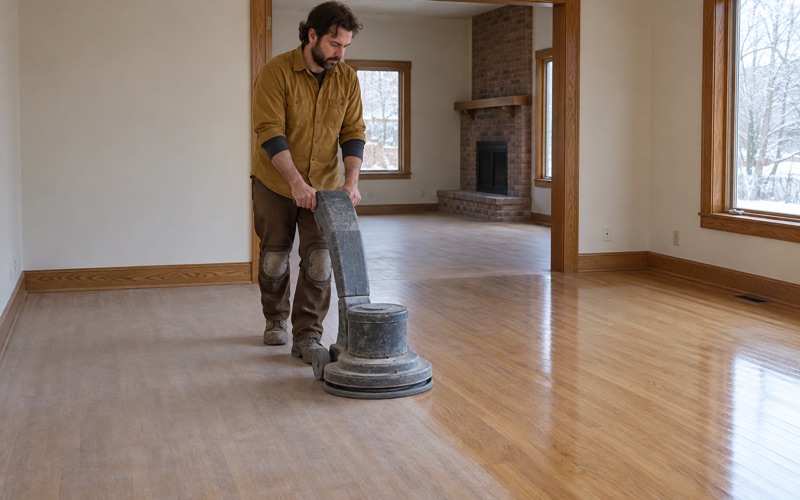
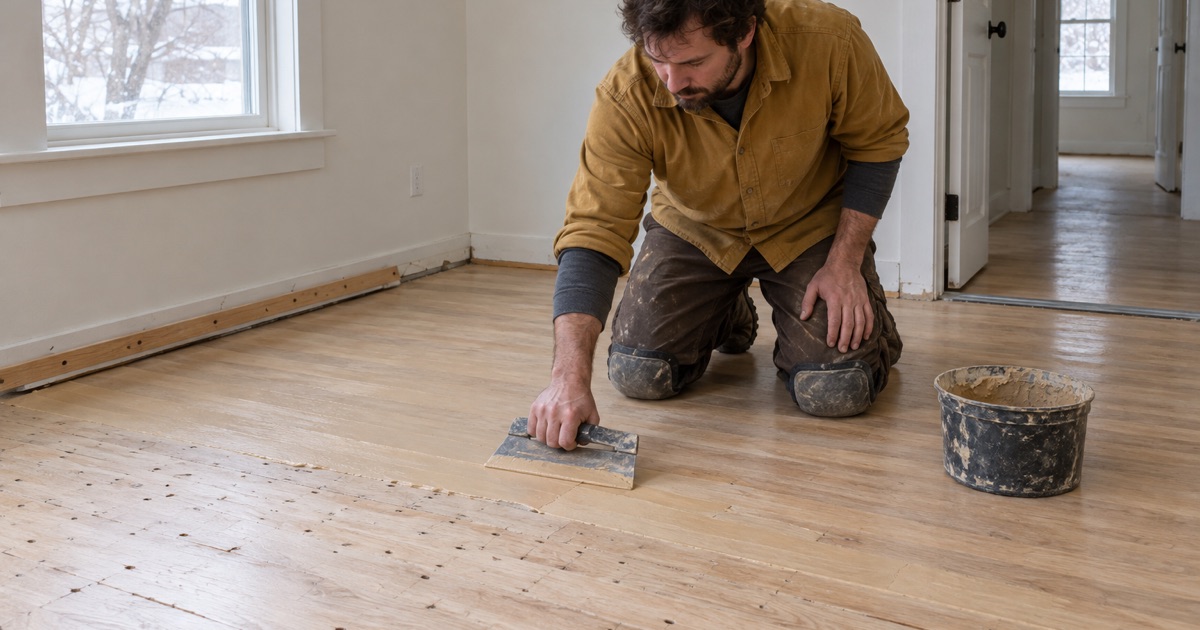
A full sand is a different job with a different calendar. The grit sequence runs in order with the drum sander and the edger kept in step, trowel-fill closes what is open, and a step skipped early shows up permanently as chatter marks, drum marks or edger swirl locked under the finish.
When the plank cannot be sanded at all
A great deal of the apartment and townhome stock from the 1970s onward is engineered plank rather than solid strip, and engineered flooring carries only a finite thickness of wood above its core. We measure the wear layer before quoting a sand, rather than inferring it from how the surface looks at the doorway.
Below the sanding threshold the honest answer is replacement. Taking a drum to a veneer that thin produces sand-through at the pinch points and delamination afterward, and that second invoice lands while the unit is still empty and still not earning.
Chemistry, coats and the day it can be shown
Finish reaches our quote as chemistry, coat count and cure schedule. Waterborne polyurethane and oil-modified polyurethane do not dry, cure, smell or amber on the same clock, and in a rental that difference is a leasing date rather than a matter of taste.
Then we write the dates down as dates. When furniture returns, when rugs return, when pets return, and for a rental when the unit can be shown — because a rug laid on a curing finish leaves a mark shaped like the rug, and white haze or blush from a coat trapped too early is a return trip costing more days than the wait would have.
Working around the neighbors
In a building of that size the other units stay occupied while yours is empty. We describe dust containment by the equipment coming off the truck and where its exhaust actually vents, rather than by the word dustless, which nothing involving a drum sander has ever deserved.
Where the unit sits in an association building, we quote against that building’s own recorded governing documents. Those supersede any single sound rating, are often stricter than one, and are also where the working hours, elevator reservations and floor-covering restrictions are written down.
The Older Owner-Occupied Core
The other 3,487 households here own their homes, and 2,371 of those owners are in one-unit detached houses. It is the minority segment in this city, and it holds the oldest floors in it.
The prewar remainder
917 units, 9.0 percent of the stock, date from 1939 or earlier. Mainstreet between 8th and 11th Avenues North was listed on the National Register of Historic Places in January 2022 as the Hopkins Commercial Historic District, and the residential stock of that same era is the oldest wood flooring we get asked to work on here.
Those floors tend to be narrow solid strip, often already sanded more than once, so the governing number is how much wood is left above the tongue. Anything built before 1978 also brings the federal renovation, repair and painting rule into the job, which reaches this work directly because Minnesota does not run an authorized program of its own.
An owner’s floor runs on a different calendar
An owner-occupied refinish has no turnover clock, and that is a genuine advantage. The work can be staged a level or a wing at a time, around a household’s own week, instead of being compressed into the gap between two leases.
What it cannot sidestep is the heated season. State law holds a rented home at a minimum of 68 degrees from October 1 through April 30, and that statutory seven-month stretch describes the indoor winter of most buildings in this city. It is when a wood floor gives moisture back to the room, and we name it before the work is booked rather than after the gaps appear.
Gapping, acclimation, and what is actually wrong
Boards that open in February and close again by midsummer are answering that cycle rather than failing. Before anything is fastened we set an equilibrium moisture content target for the building and take a subfloor moisture content reading beside it, then derive the acclimation period from those two numbers instead of from a standard week.
Cupping is a different message, and dry cupping left behind by a rushed sanding schedule can look identical from a doorway while having nothing to do with the season. Reading those apart before the sander comes out is the difference between fixing a floor and sealing a moisture problem under three coats.
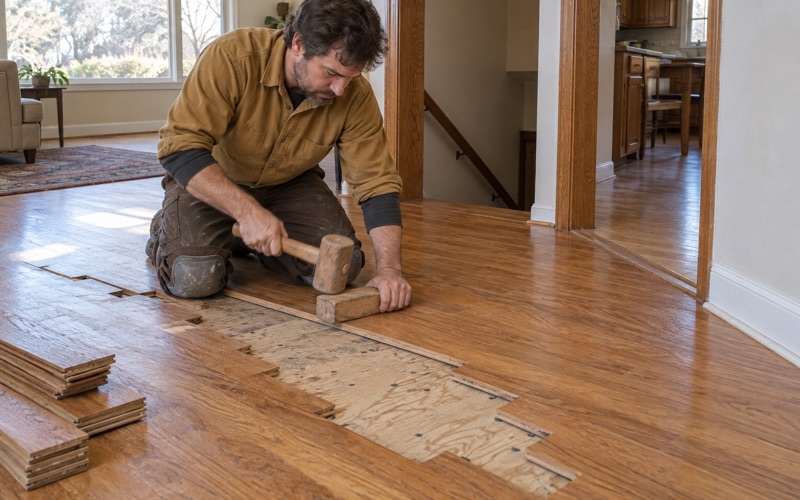
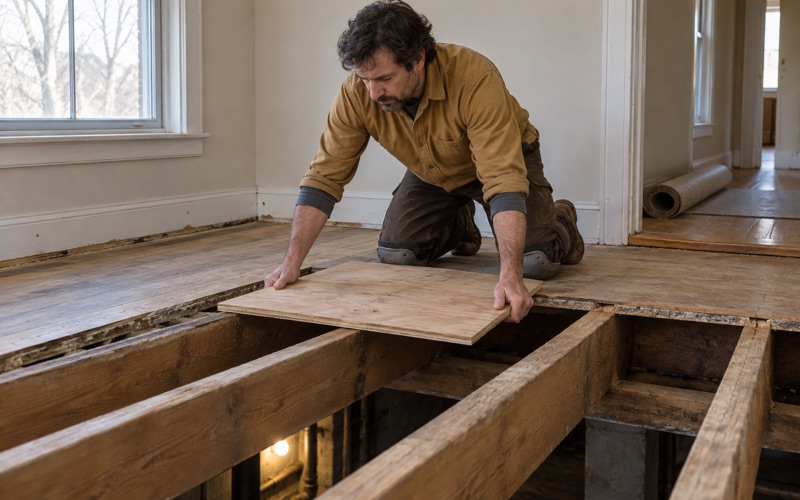
Landlord or owner, the estimate here reads the same way. A price per square foot with the minimum project size printed beside it, structural subfloor repair carried on its own line because it sits on the far side of the state’s permit exemption from finish work, and a cure schedule written in calendar dates — so the day the floor is done is a day someone can plan around.
- 20+ Years Experience
- Written Price Per Square Foot
- Moisture Tested Before Quoting