
Maple Grove Wood Flooring has been handling water damaged hardwood floor repair in Maple Grove, MN for more than 20 years, serving surrounding cities including Dayton, Brooklyn Park, Champlin, Corcoran and Plymouth. This is the one job on the site where the clock is genuinely running, and the single most expensive mistake is waiting to see whether the floor recovers on its own.
Water does its worst work where nobody is looking. It travels along the underside of the boards, through the tongue and groove, into the subfloor and out along the joists, so the wet area is almost always larger than the stain you can see. A floor that looks like it took a small hit at the dishwasher has frequently wet a third of the room by the time anyone checks with a meter.
So the first visit is instruments and documentation, not demolition. We meter the flooring and the subfloor at fixed reference points, map the extent of the wet area by sounding and reading rather than by eye, photograph what we find, and decide from the numbers whether this floor dries in place or comes up. Every one of those readings is written down, because they are the record that everything afterward rests on.
The First Forty-Eight Hours
What to Do Before Anyone Arrives
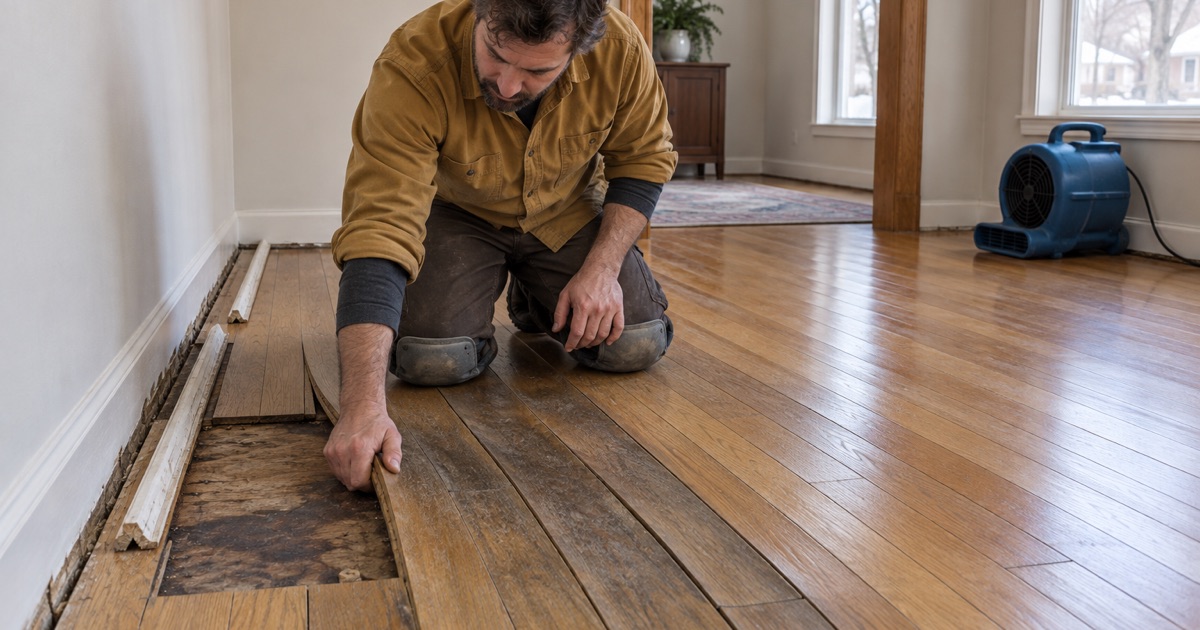
Stop the source, get standing water off the floor, lift rugs and anything holding moisture against the boards, and start air moving. A dehumidifier running in a closed room does more good than a fan pointed at one wet patch. What not to do is apply heat aggressively, because drying the face of a board much faster than its back is how a cupped floor becomes a crowned one, and crowning is a sanding problem rather than a drying problem.
Metering, Mapping and Documenting the Extent
We establish reference points and read them: flooring moisture content, subfloor moisture content, and room relative humidity, recorded on every visit so a trend exists rather than a single snapshot. The wet boundary is mapped by reading and sounding outward until the numbers come back to normal. That map is what determines how much floor is in scope, and it routinely runs well past where the discoloration stops.
Drying in Place Versus Taking Boards Up
A floor dries in place when air can reach both sides of the boards and the readings actually move. Where the underside is sealed against a slab or trapped over a wet subfloor, they will not move, and continuing to run equipment at it just burns weeks. Sometimes the answer is selective removal to open the assembly and dry what is beneath it, which saves the surrounding floor. We make that call from the readings rather than from the first day’s appearance.
Where the Water Came From Changes the Repair
Supply Lines, Appliances and Water Heaters
Clean water from a supply line, an ice maker line, a dishwasher or a failed water heater is the most recoverable category, because the water itself is not contaminated and the loss is usually caught quickly. The pattern is a saturated core spreading outward along the boards. These are the losses where drying in place succeeds most often, and where acting inside the first two days genuinely changes the outcome.
Ice Dams and Water From Above
Water that has come through a ceiling after an ice dam arrives having traveled, so it enters the floor in places that look unrelated to the leak. It also tends to arrive repeatedly over a thaw cycle rather than all at once, which means a floor can be wetting and partly drying for weeks before anyone sees a cupped board. We read well beyond the visible area on these, and we expect to find moisture in the subfloor that the flooring above it is hiding.
Sump Failure and Water From Below
On a lower level the water is often coming up rather than down, and the floor is the last thing to show it. A sump that failed, a drain tile that has silted, or a slab that has always passed moisture will keep feeding a floor no matter how hard the room is dried. Repairing the floor before the source is resolved guarantees a second loss, so we read the slab itself and say plainly when the cause is still live.
What Water Does to a Wood Floor
Cupping, Crowning and Buckling
Cupping is the first stage: the underside takes on more moisture than the face and the board edges rise. Crowning is the mirror image, and very often it is a cupped floor that somebody sanded flat before the wood had finished giving the water back. Buckling is the end of the road, where boards expand until they release from their fasteners or adhesive and lift clear of the subfloor. The first is usually recoverable, the second is a sanding sequencing failure, and the third generally is not.
Black Staining and What Sanding Cannot Remove
Water that sat produces dark staining as the wood reacts, and it goes as deep as the water went. Sanding removes finish and a fraction of a millimeter of wood, which handles surface discoloration and does nothing at all for a stain that has traveled the full thickness of the board. We tell you which boards will come back with the grit sequence and which have to be cut out and woven in, before you pay for a sanding that was never going to fix them.
Adhesive Failure, Delamination and the Subfloor
Under the surface, water attacks the connections. A glue-down floor loses its bond and starts sounding hollow, an engineered board can delaminate between the wear layer and the core, and sheathing swells at its edges and separates at the plies. None of that is visible from above, which is why we sound the field and probe rather than judging by the boards. Structural sheathing replacement is quoted as its own line, separate from the finish flooring work.
Insurance, Documentation and What It Costs
The Readings Are the Record
Everything downstream of a water loss — scope, price, and any claim you make — rests on what was measured and when. So we record it: readings at fixed points on every visit, the mapped extent, photographs, the species and construction of the floor, and what the repair actually requires. A documented trend showing a floor stalled two points high is a fact. An opinion that the floor still feels damp is not.
Like Kind and Quality Under Minnesota Law
We do not adjust claims and we do not speak for any carrier. What is worth knowing is that Minnesota’s claims practices statute requires repair to like kind and quality and bars depreciation on items not adversely affected by age or use. Detailed documentation of the floor as it was, and of what an equivalent repair requires, is what turns that from a general principle into something specific about your floor.
Repair, Partial Replacement or the Whole Floor
The arithmetic changes with how far the water traveled. A contained loss on a site-finished floor is a board replacement and a room refinish, and it disappears. A loss that has crossed into open field, or that involves a prefinished product that can no longer be matched, often makes replacing to a natural break the cheaper and better-looking answer. We put both numbers in front of you rather than scoping the larger one by default.
- 20+ Years Experience
- Written Price Per Square Foot
- Moisture Tested Before Quoting